


Consultant Dermatologist led Skin Assessment
At Kent Skin and Laser Clinic, we provide Consultant Dermatologist led assessment of suspected skin cancer, including evaluation of moles and skin lesions of concern.
Assessment is focused on accurate diagnosis, early detection and appropriate investigation, ensuring that any concerning changes are identified and managed in a timely and clinically appropriate manner.
Dermatology-Led Skin Assessment
At Kent Skin and Laser Clinic, we provide Dermatologist-led assessment of suspected skin cancer, including evaluation of moles and skin lesions of concern.
Assessment is focused on accurate diagnosis, early detection and appropriate investigation, ensuring that any concerning changes are identified and managed in a timely and clinically appropriate manner.


What is a skin cancer assessment?
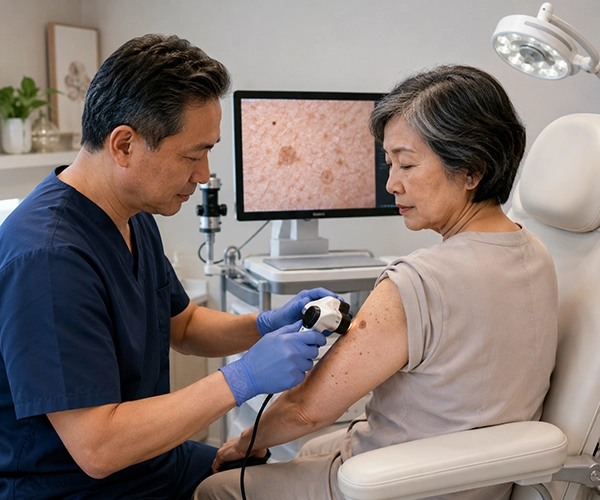
A skin cancer assessment involves a detailed examination of the skin, moles and lesions to identify features that may indicate abnormal or malignant change.
All assessments are performed within a dermatology setting, allowing for thorough evaluation and clinical accuracy.
Conditions assessed
Assessment includes evaluation of a wide range of skin cancers and pre-cancerous conditions, including:
- Melanoma
• Basal cell carcinoma (BCC)
• Squamous cell carcinoma (SCC)
• Actinic keratoses
• Bowen’s disease
Any mole or lesion of concern can be assessed, including those that are new, changing or symptomatic.
Clinical assessment
Consultation includes:
- Detailed medical and skin history
• Full skin examination or focused lesion assessment
• Dermatoscopic analysis (magnified skin examination)
• Identification of any features requiring further investigation
The aim is to determine whether a lesion is benign, requires monitoring, or requires further investigation or treatment.
Diagnostic investigations
Where indicated, additional investigations may be recommended:
- Skin biopsy for diagnostic confirmation
• Histological analysis
• Further dermatological testing where appropriate
These investigations allow for definitive diagnosis and appropriate management planning.
Management of suspicious lesions
If a lesion requires further evaluation or treatment:
- Findings are explained clearly
• Appropriate next steps are discussed
• Biopsy or removal may be arranged where indicated
• A management plan is outlined
Timing of treatment is guided by clinical findings and individual need.
Where treatment is required, this may form part of a broader care pathway including Skin Surgery for definitive management.
Clinical considerations
Assessment is not limited to clearly abnormal lesions. Evaluation may also be appropriate for:
- New or changing moles
• Lesions with irregular shape or pigmentation
• Persistent or non-healing areas
• Pigmented or non-pigmented lesions of concern
Early assessment supports timely diagnosis and appropriate care.
Dermatology-led approach
All lesions are assessed prior to any treatment being considered. This ensures:
- Accurate diagnosis
• Appropriate selection of investigations
• Safe differentiation between benign and malignant lesions
• Selection of the most suitable treatment where required
Management is therefore individualised rather than based on a single treatment approach.
Relationship to treatment pathways
Following assessment, management may include:
- Monitoring where appropriate
• Skin surgery
• Non-surgical therapies
• Further specialist investigation
Treatment decisions are based on clinical diagnosis and overall management requirements.
FREQUENTLY ASKED QUESTIONS
Not all moles require assessment; however, any mole that is new, changing or of concern should be evaluated.
Many lesions can be assessed clinically, although biopsy may be required to confirm diagnosis in some cases.
Biopsy is only recommended when clinically indicated to confirm diagnosis or guide management.
Management depends on clinical findings. Some lesions may be monitored, while others may require biopsy or removal.
This depends on the nature of the lesion and clinical assessment. In some cases, treatment can be arranged promptly.